
newsletter: the categories that are betting on TV
July 8, 2026
The Categories that are Using TV to Grow Share of Voice and Share of Market
Recent Media Radar data reveals which categories grew their TV investment in 2025 and what it signals about where trust, attention, and share of voice are headed.
If your competitors are pulling back on TV, don’t relax, see it as an opportunity. The latest data from Media Radar shows that while overall Canadian TV investment softened slightly in 2025, a distinct group of marketers made the opposite choice: they leaned in. With the fall season right around the corner, it’s worth understanding why before you finalize your media mix.
Across every category, from global consumer goods giants to first-time challenger brands, a cohort of growth-oriented marketers increased their TV commitment in 2025. The headline number undersells the story. Here’s what’s happening, and what it might mean for your category.
The takeaway for your planning: when a category pulls back broadly, the brands that hold or grow their share of voice don’t just maintain visibility, they capture an outsized share of it and turn that attention into real market-share gains. This dynamic shows up repeatedly in this year’s data.
Categories Growing on TV
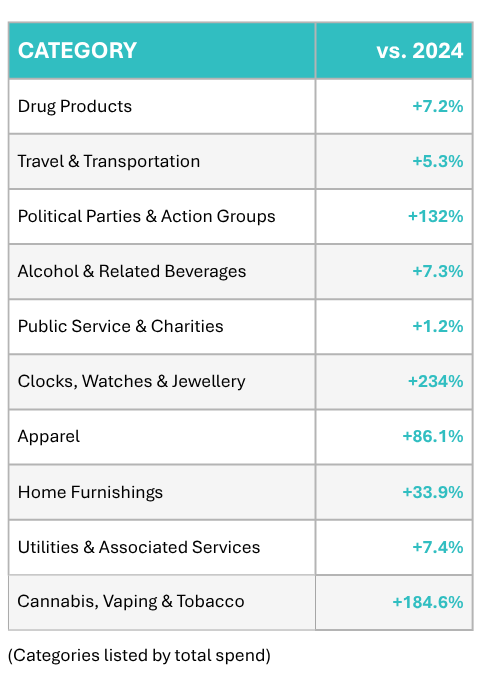
While the overall market played it safe, certain categories grew their TV investment year over year, a clear signal of how television proves its return. Two of the top ten categories by spend moved upward, and several mid-tier categories posted double- and triple-digit growth that reflects deliberate strategy, not coincidence.
Drug Products and Travel are instructive examples. Both are high-consideration categories, the kind where a buyer needs time, trust, and repeated exposure before acting. If you work in a category like these, take note: TV’s ability to build that trust at scale, in a lean-back environment, is exactly why these advertisers keep reinvesting. Jewellery’s +234% jump (climbing 14 places in the rankings) tells a similar story: the power of TV to create demand.
Sub-Categories Surging Up the Ranks
Zoom in another level to product class and the growth story is even more compelling, with several categories climbing more than 70 positions in a single year.

Airlines Are Back on TV
Airlines increased TV spend by 163%, rocketing 70 spots in the rankings. With Canadians travelling more and competition intensifying for discretionary dollars, carriers returned to television for exactly what it does best: building emotion-based desire for destinations and building brand preference before travellers are ready to book. TV is the mass-reach, high-impact storytelling medium that no other channel replicates at scale.
If your category needs to be top-of-mind ahead of a high-stakes decision, this is a playbook worth studying.
365 New-to-TV Companies
You don’t need a legacy-sized budget for an effective TV campaign. In 2025, 365 companies with no TV history over the last five years advertised on Canadian TV, together investing $32.4 million. These top new entrants span health technology, travel, SaaS, consumer goods, and food categories, more proof that TV is an accessible, worthwhile investment across a wide range of categories and company sizes.
What the Growth Brands Understand
None of this year’s growth was accidental. Four strategic principles show up repeatedly in the data and are worth keeping in your back pocket for your next planning conversation.
1. Share of voice compounds. When competitors pull back in uncertain times, the brands that hold or grow their TV presence capture a disproportionate share of consumer attention. One leading auto brand’s 40% increase while other automotive brands retreated is the clearest example in this year’s data.
2. Television earns trust in high-consideration categories. Drug products, financial services, medical clinics, and prescription medications all grew on TV in 2025, categories where the stakes of a wrong decision are real, and where a broadcast environment conveys a legitimacy that digital alone does not replicate.
3. New brands need TV to scale. The 365 new advertisers who entered TV in 2025 weren’t unaware of the alternatives; they’d already built performance-channel audiences. They chose TV because at a certain stage, there’s no effective substitute for the mass, simultaneous reach they require to grow. Bombas is a great example: a direct-to-consumer brand that built its early audience through performance media, then turned to TV to grow beyond it.
4. Emotional categories need emotional media. Jewellery, airlines, beer, and apparel, the categories that grew most dramatically on TV in 2025, are the ones where desire and aspiration drive the purchase. Emotional impact delivered by sight, sound, and motion in a high-attention environment is what TV does best.
Where does your brand fit into this story? Reach out! We’re happy to walk through what these trends mean for your media plan.
Source: Media Radar, June 2026